Agartala, December 2:
Marking 28 years since the signing of the 1997 Chittagong Hill Tracts (CHT) Peace Accord, Chakma intellectuals and rights activists on Tuesday urged India to adopt a more assertive approach as the situation in Bangladesh’s CHT region worsens amid growing radicalisation.
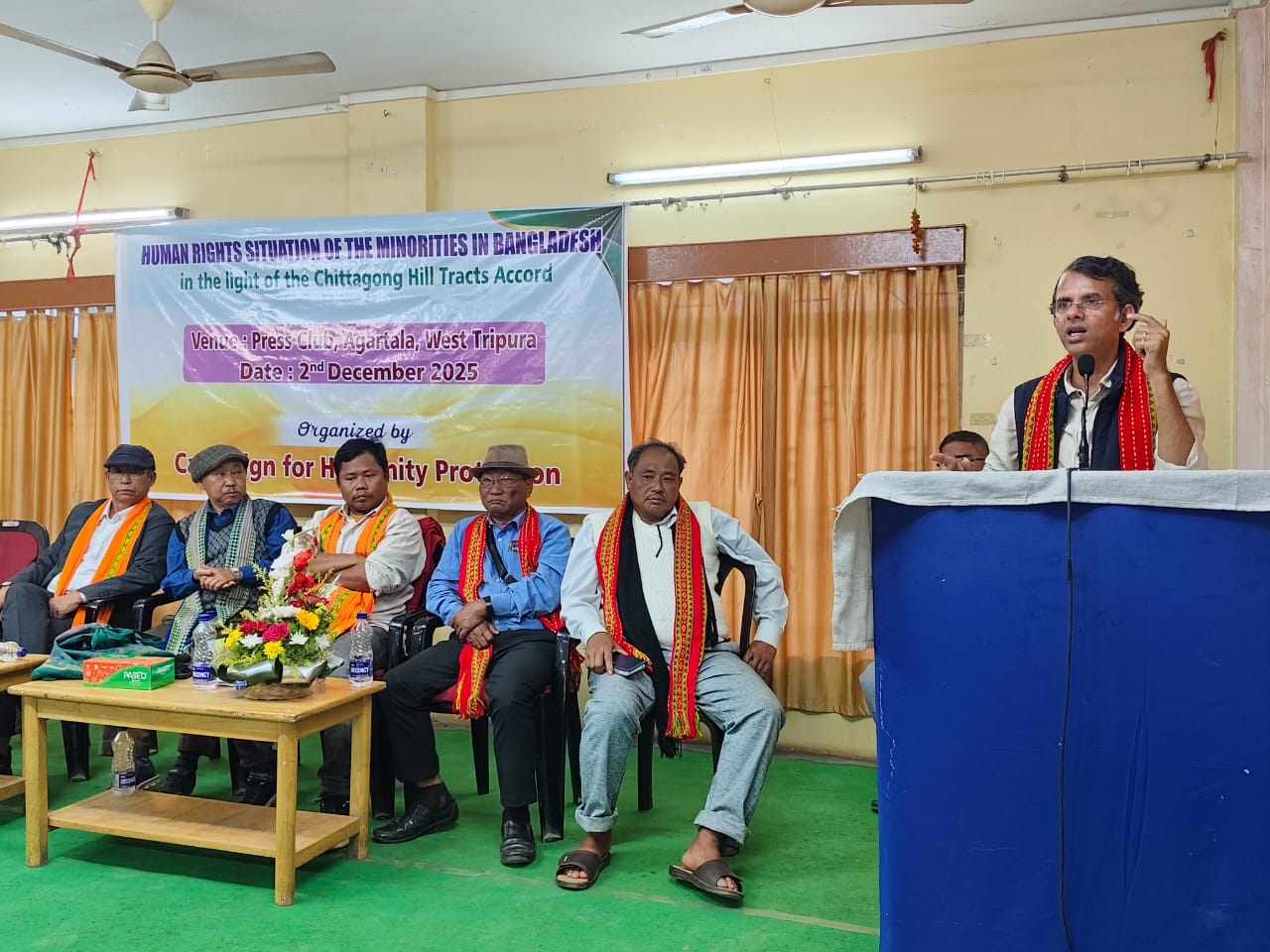
Speaking at a discussion on “Human Rights Situation of the Minorities in Bangladesh in the light of the Chittagong Hill Tracts Accord,” organised by Campaign for Humanity Protection at the Agartala Press Club, experts warned that the deteriorating conditions in the CHT pose a direct national security concern for India.
Participants noted that after the fall of the Sheikh Hasina government during the August 2024 student-led uprising and the subsequent rise of the Muhammad Yunus–led interim regime, Bangladesh has witnessed an alarming surge in radical Islamist influence. Combined with the long-standing non-implementation of the Peace Accord, the CHT has entered an unstable and increasingly violent phase.
Dr. Shyamal Bikash Chakma, Research Officer at Tata Institute of Social Sciences, said India must shed its passive stance. “If indigenous people are displaced and outnumbered due to rising radicalisation, the repercussions will inevitably spill over into India through refugee influx and border instability,” he cautioned.
He argued that shifting geopolitical priorities have pushed the CHT off India’s strategic radar—a mistake he said could prove costly. “If the Accord continues to be ignored, India must recognise that this is no longer only Bangladesh’s internal matter. It is a direct threat to our national security,” he said.
Chakma socio-cultural activist and writer Niranjan Chakma described the situation on the ground as “lawless,” citing daily incidents of arson, rape, dacoity, and land grabbing, with indigenous people facing systemic marginalisation.
Speakers highlighted that only 25 of the Accord’s 72 clauses have been implemented in 28 years, leaving crucial issues like land rights, autonomy, and administrative reforms untouched. They called on India, the US, EU and global human rights bodies to pressure Dhaka to implement at least 80% of the Accord to ensure the survival of the indigenous Jumma communities.