Agartala, May 3:
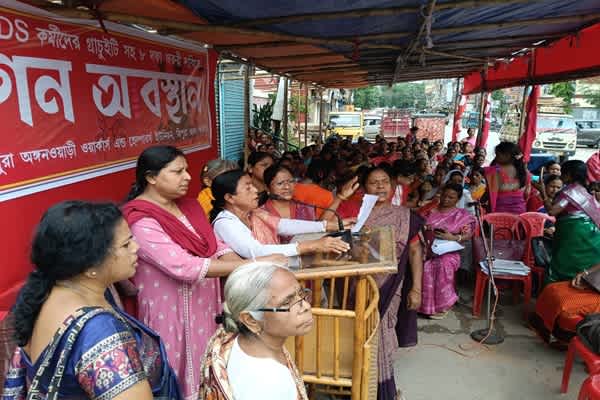
The simmering discontent among Anganwadi workers and helpers in Tripura came to the fore on Sunday as hundreds assembled at Paradise Chowmuhani in Agartala, staging a massive sit-in protest to press for long-pending demands.
Organised by the Tripura Anganwadi Workers and Helpers’ Union, the demonstration revolved around an eight-point charter of demands, with regularisation of services and fair wages emerging as the central issues. Protesters called for all Anganwadi workers and helpers to be brought under permanent employment, arguing that years of service have gone unrecognised in terms of job security and benefits.
A key demand included a minimum monthly salary of Rs 41,000 for Anganwadi workers and Rs 35,000 for helpers. In addition, the union sought the introduction of gratuity and pension benefits, stating that the current honorarium-based system fails to provide financial stability or dignity to frontline workers.
Addressing the gathering, several speakers accused the government of relying heavily on Anganwadi workers for the implementation of crucial welfare schemes while denying them basic entitlements. They highlighted the pivotal role played by these workers in delivering services related to child nutrition, healthcare, and early childhood education at the grassroots level.
The union also raised concerns over the possible closure of Anganwadi centres, asserting that such a move would severely impact essential services for children and mothers. Protesters insisted that all centres must remain operational to ensure uninterrupted delivery of welfare programmes.
The agitation carried a strong warning for the authorities. Union leaders stated that if their demands are not addressed promptly, the protest would intensify in the coming days. “We have shown patience for years, but we will now be forced to escalate our movement if the government continues to ignore us,” a union representative said.
With growing participation and visible public support, the protest has added pressure on the state government to initiate dialogue and take concrete steps before the situation escalates further.