Agartala, Oct 26 : A scientist from Kailashahar in Tripura has advocated an irrigation-led strategy to help African nations achieve rice self-sufficiency and reduce dependence on imports, emphasising the role of modern water-management systems in boosting agricultural productivity and strengthening food security.
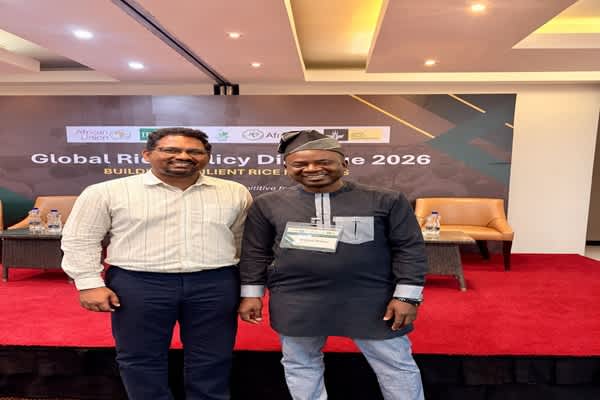
Dr Deb, head of the Water and Climate Research Unit at the International Rice Research Institute’s (IRRI) South Asia Regional Centre in Varanasi, presented a roadmap for improving rice production at the recently concluded Global Rice Policy Dialogue in Addis Ababa, Ethiopia.
Addressing policymakers, researchers and development experts, he stressed the need to identify regions with high agricultural potential and prioritise investments in irrigation infrastructure to improve productivity rather than relying solely on expanding cultivated areas.
Efficient irrigation systems and scientific water-management practices can help African countries increase domestic rice production, improve farmers’ incomes and strengthen resilience against climate-related challenges, he said.
The two-day dialogue, organised with the support of the African Union, IRRI, AfricaRice and the Ethiopian Institute of Agricultural Research, brought together policymakers and experts to discuss agricultural reforms, technological innovation and food-security challenges facing the continent.
As part of international collaboration, Dr Deb is working with the Kenyan government to develop a framework for identifying regions where irrigation investments could deliver significant agricultural benefits. The initiative aims to improve agricultural productivity while ensuring the sustainable use of water resources.
His research also covers agricultural water management in India. In Kerala, he is associated with a World Bank-supported initiative to digitally monitor water flows across a canal-irrigation network covering more than 20,000 hectares.
The project seeks to improve water distribution and support more informed decisions on irrigation management.
Dr Deb is also collaborating with NASA scientists to validate data from the NASA-ISRO Synthetic Aperture Radar (NISAR) mission. The research aims to integrate satellite observations with agricultural and water-resource studies to improve irrigation planning, climate monitoring and crop management.
His work spans irrigation engineering, climate adaptation and sustainable farming, linking scientific research with practical solutions to agricultural challenges.
After completing his doctoral studies at the University of Newcastle in Australia, Dr Deb pursued postdoctoral research at the University of Alabama in the United States.
His international research collaborations focus on addressing food-security challenges and promoting sustainable agricultural practices through improved water management and scientific innovation.