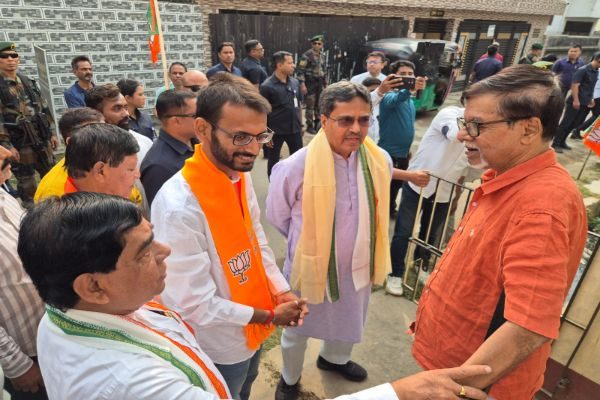
Agartala, Nov 16 : Tripura Chief Minister Manik Saha on Saturday said his government was committed to preserving the history, culture and heritage of Janajati communities while ensuring inclusive development, as he virtually inaugurated four Eklavya Model Residential Schools (EMRS) in the state.
The schools at Manikpur, Manu, Hezamara and Ompi were inaugurated during a programme organised at Manikpur in Dhalai district’s Longtarai Valley subdivision to mark the 151st birth anniversary of tribal freedom fighter Bhagwan Birsa Munda.
Addressing the gathering on Janjatiya Gourav Divas, Saha said 14 of the 21 EMRS sanctioned for Tripura were already operational, while the four newly inaugurated institutions would expand access to quality residential education for tribal students.
He expressed hope that another 15 such schools would be sanctioned for the state, subject to fulfilment of the prescribed eligibility criteria.
Paying tribute to Birsa Munda, the chief minister recalled the contribution of tribal communities to India’s freedom struggle, social reform, education, agriculture, environmental protection and nation-building.
He said the Centre had declared November 15 as Janjatiya Gourav Divas to honour the contribution of tribal freedom fighters.
Emphasising education as a key instrument of socio-economic transformation, Saha said the state government was providing hostel facilities, stipends, grants and pre-matric and post-matric scholarships to tribal students.
He also highlighted various initiatives, including the PM-JANMAN scheme, Dharti Aaba Janjatiya Gram Utkarsh Abhiyan and the Mukhyamantri Janajati Unnayan Mission, launched in November 2023.
Under the latter initiative, 50 residential hostels equipped with solar power, safe drinking water and other modern facilities have been constructed. The government also provides annual UPSC coaching support to 40 meritorious tribal students, he said.
Referring to the Mukhyamantri Rubber Mission, Saha said nearly 30,000 hectares had been brought under rubber cultivation in the state over the past five years to strengthen the livelihoods of rubber growers.
He said yarn was distributed to around 30,000 tribal women in 2025 to promote traditional skills and livelihood opportunities, while another 45,000 women were proposed to be covered under the initiative.
The chief minister also highlighted the development of modern sports facilities for tribal youth and underscored the role of traditional community leaders in preserving cultural heritage and maintaining social harmony.
Tribal Welfare Minister Bikash Debbarma, MLA Shambhulal Chakma and senior government officials attended the programme.