Mysuru, Nov 13 : Prime Minister Narendra Modi on Friday said no country could afford to slow down its progress amid rapidly changing technology, asserting that India was building a strong ecosystem for science, research and innovation to keep pace with global advancements.
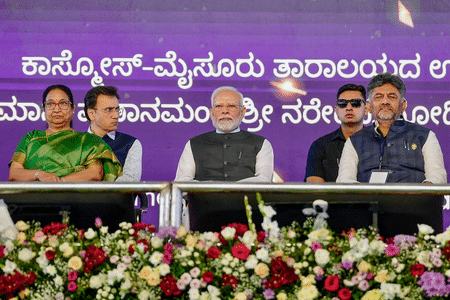
Speaking after inaugurating COSMOS-Mysuru Planetarium, India’s first LED Dome planetarium, he said the country had made significant strides in astronomy, astrophysics and space exploration over the past decade, with several achievements placing it among a select group of nations capable of undertaking complex space missions.
“Today, technology is changing rapidly. No country can take the risk of undermining or slowing down its progress. A strong ecosystem for science and research is being created in the country,” Modi said.
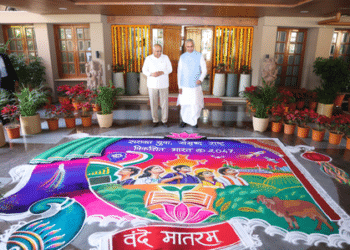
He described the inauguration of the planetarium as another milestone in promoting scientific temper and encouraging research, particularly among the younger generation.
Recalling his earlier visit to Mysuru for the inauguration of Viveka Smaraka, Modi said the two institutions carried complementary messages. While Viveka Smaraka encouraged people to explore their inner selves, the planetarium would inspire them to look towards the universe and understand its mysteries.
“In Bharat, the traditions of science and spirituality have always travelled together,” he said, highlighting India’s ancient contributions to astronomy.
The Prime Minister recalled the contributions of renowned astronomers Aryabhata, Bhaskaracharya and Nilakantha Somayaji, who studied celestial movements, calculated planetary positions and developed calendars without access to modern instruments.
He also highlighted Mysuru’s contribution to education and scientific research, referring to the establishment of the University of Mysore during the reign of Maharaja Nalvadi Krishnaraja Wadiyar and the Wadiyar family’s role in setting up the Indian Institute of Science in Bengaluru.
Referring to India’s space achievements, Modi said the Chandrayaan-3 mission had made the country the first to successfully land near the Moon’s south polar region, while the Aditya-L1 mission had established a dedicated space-based solar observatory.
He also highlighted India’s achievement in space docking and undocking, saying the country had become the fourth in the world to demonstrate the capability.
The government had opened up the space sector, creating opportunities for startups and young entrepreneurs to develop rockets and undertake ambitious projects, he said.
Emphasising the practical applications of space technology, Modi said ISRO’s initiatives were helping fishermen, improving railway tracking and supporting crop insurance schemes.
“Our satellites are reaching their designated orbits, and their applications are being used for the welfare of people. Science for society is our approach,” he said.
The Prime Minister also highlighted the Rs 1 lakh crore research and innovation initiative launched last year to strengthen India’s scientific ecosystem.
Praising Indian students for winning four gold and one silver medal at the International Olympiad on Astronomy and Astrophysics in Vietnam this year, he said young people had immense potential when provided with adequate opportunities and resources.
Urging schools and colleges to encourage students to visit the planetarium, Modi said nurturing scientific curiosity among children was essential for future discoveries.
Governor Sudha Yadav, Union Finance Minister Nirmala Sitharaman, Chief Minister D K Shivakumar, Higher Education Minister Basavaraj Rayareddy and BJP MP Yaduveer Wadiyar were among those present.