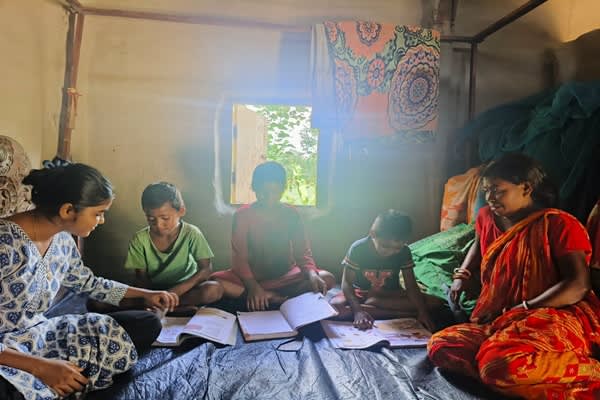
Agartala, September 17: In Joyshree Para village, Namita Das is turning a small amount of financial assistance into a series of practical steps aimed at improving life for her family.
The Rs 1,500 she received through Community Support Group (CSG) assistance has been used for three purposes: insurance protection, educational needs for her children and the purchase of two chickens as the starting point of a livelihood activity.
Namita shares a six-member household with her husband, a daily wage labourer, her elderly mother-in-law Moyna Bala Das and three school-going children. With household earnings dependent largely on daily-wage work, managing regular expenses and buying books and stationery for the children has often been difficult.
Her entry into the programme came through the Tripura Rural Livelihood Mission’s (TRLM) TR-SAY Project. Her mother-in-law was initially selected to participate, but her age and health issues made regular attendance at meetings difficult.
Namita subsequently took her place at the meetings. Over time, she moved from simply representing her mother-in-law to actively participating in Small Group Meetings (SGMs), where she began engaging in discussions and learning about financial and livelihood opportunities.
With support from a Parivartan Sakhi, Namita reactivated her dormant bank account and received Rs 1,500 under the CSG assistance.
She allocated Rs 500 towards insurance and enrolled in the Pradhan Mantri Jeevan Jyoti Bima Yojana (PMJJBY) and Pradhan Mantri Suraksha Bima Yojana (PMSBY). Another Rs 600 was spent on books and stationery for her children.
The remaining Rs 400 was used to buy two chickens, marking her first step towards a small-scale poultry-based income activity.
Namita said the assistance has helped her ensure that her children have the educational materials they need.
“Now my children will also be able to go to school with good books and stationery,” she said.
Beyond the financial support, the programme has also contributed to a change in Namita’s confidence and participation. She now speaks more freely during community meetings and has begun working on a livelihood plan of her own.
Her experience reflects how small interventions can help women take greater responsibility for financial decisions, access formal banking and insurance services and explore additional livelihood opportunities.
The changes in Namita’s household have come through a handful of carefully considered choices rather than a single major intervention.
For her, the reactivated bank account, insurance enrolment, school supplies and two chickens represent the first steps towards greater family security and a more stable future for her children.