Agartala, September 1:
Senior CPI(M) and All India Kisan Sabha (AIKS) leaders on Tuesday launched a sharp attack on the BJP-led governments at the Centre and in Tripura, alleging that democratic institutions were being weakened and the agrarian crisis had deepened despite repeated promises to farmers.
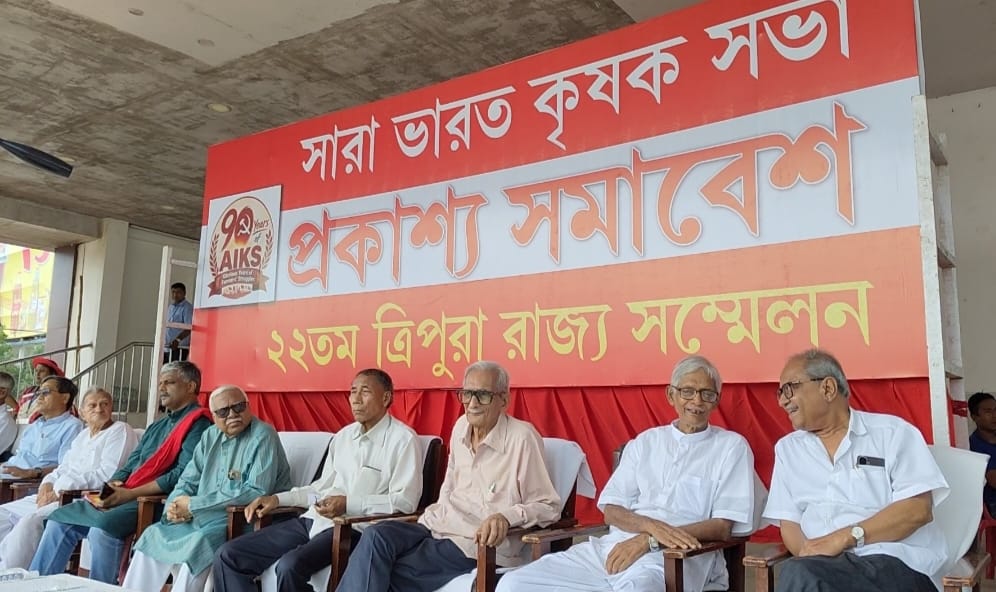
Addressing a large gathering at Vivekananda Maidan here on the occasion of the 22nd state conference of the AIKS, CPI(M) Tripura state secretary and Leader of the Opposition Jitendra Chaudhury alleged that democratic rights and institutions had come under increasing pressure in the state.
Referring to the recently announced elections to the Village Committees under the Tripura Tribal Areas Autonomous District Council, Chaudhury said the polls, being held after a prolonged delay, demonstrated the importance of restoring democratic institutions.
He alleged that institutions ranging from panchayats and panchayat samitis to the ADC and Village Committees had suffered during the period of BJP rule.
Chaudhury also raised the issue of the recent unnatural death of Tripura DGP Anurag in his office chamber, questioning the circumstances surrounding the incident and the government’s handling of the matter.
“If the state’s highest-ranking police officer could not protect his own life in one of the most secure offices, how can ordinary citizens, workers and other sections of society expect to exercise their rights?” he asked, alleging that the incident had raised serious questions about the state of democracy and governance in Tripura.
He accused the BJP and RSS leadership of seeking to establish a political model in Tripura that, according to him, undermined constitutional institutions, individual freedom, freedom of expression and democratic rights. He further alleged that attacks on farmers, workers, youth, women and children were part of a wider assault on people’s rights.
AIKS general secretary Dr Biju Krishnan, addressing the gathering, criticised the BJP-led government at the Centre over its agricultural policies, saying that promises made to farmers had not been fulfilled.
Krishnan said the government had promised to implement the recommendations of the Swaminathan Commission, ensure a minimum support price of at least 50 per cent above the cost of production, double farmers’ income, provide 200 days of employment under MGNREGA, waive farm loans and expand irrigation facilities.
“Instead, the crisis of farmers has only increased,” he alleged.
He claimed that more than five lakh farmers, agricultural workers and migrant workers had died by suicide across the country over the past 14 years, while alleging that farmers in Tripura were also facing serious problems.
According to Krishnan, paddy farmers in Tripura were not receiving remunerative prices and were allegedly being forced to sell at rates around Rs 700 to Rs 1,000 below the MSP in the absence of adequate procurement. He also alleged shortages and black marketing of urea, difficulties faced by rubber growers and delays in issuing land pattas to landless people.
The AIKS general secretary further alleged that implementation of forest rights was being hampered and that agricultural land and forest land were increasingly being acquired in favour of large corporate interests.
Taking aim at the Centre’s economic policies, Krishnan described the government’s approach as a “Modi-Adani-Ambani model of corporate loot”, alleging that national resources, including ports and airports, were being handed over to corporate groups close to the government.
He also questioned the government’s handling of bad loans and referred to the reported settlement of large corporate dues, contrasting it with the treatment of ordinary farmers struggling with comparatively small agricultural loans.
On the global economic situation, Krishnan linked the difficulties over fertiliser availability and prices to geopolitical tensions involving the United States, Israel and Iran. He alleged that India’s foreign policy choices had affected supplies from Iran and Russia and criticised the government for failing to prepare adequate contingency measures.
He warned that prolonged fertiliser shortages could adversely affect agricultural production and food security, while stressing that neither farmers nor consumers were benefiting from the prevailing policies.
Krishnan also questioned the government’s ethanol-blending policy and allegations of profiteering, calling for greater transparency over beneficiaries of the policy.
The AIKS leader demanded land for the landless, saying it would help unleash productive forces, and alleged that instead of distributing land among the landless, large tracts were being acquired or allotted for corporate projects.
He also called for a shift away from the neoliberal policy framework, particularly trade liberalisation and free-trade agreements that, he alleged, were exposing Indian farmers to competition from cheaper imported agricultural products.
AIKS national vice-president Hannan Mollah, senior AIKS leader and former Tripura Deputy Speaker Pabitra Kar, former minister Aghore Debbarma and other leaders were present at the programme.
The large participation at the conference marked a major mobilisation of the CPI(M)-backed farmers’ organisation in the state, with the leaders seeking to project farmers’ livelihood concerns, land rights, employment and democratic rights as major political issues ahead of forthcoming electoral battles.