Agartala, September 26: The festive rush has begun in Kalyanpur, with traditional artisans working against time to complete idols ahead of Durga Puja. But while demand for the handcrafted images rises with the festival, idol makers say escalating input costs and a shortage of skilled workers are making the centuries-old craft increasingly difficult to sustain.
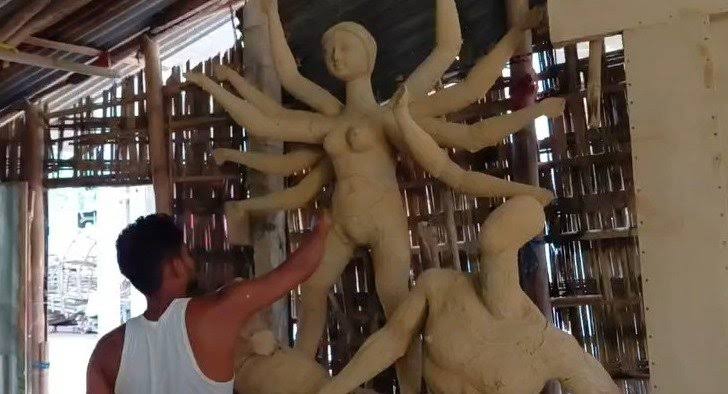
Among the artisans feeling the pressure is Bhuban Rudrapal of Kalyanpur Bazar Colony, who has been making clay idols for nearly two decades. His journey into the profession was shaped by financial necessity, after his earlier livelihood as a fish vendor failed to provide a stable income.
Rudrapal used to travel through tribal-dominated areas selling fish to support his family. He later started learning idol-making from his brother-in-law while continuing to work as a fish vendor. Gradually, the craft became his main source of livelihood.
“I learned the craft of making idols from clay from my brother-in-law while continuing to sell fish. Later, I left fish vending and took up idol-making full-time. I would make idols at home according to my own designs,” he said.
Over the years, Rudrapal has created idols of several deities, including Manasa, Kali, Vishwakarma, Loknath, Bipadnashini, Durga and Lakshmi. His work attracted customers from Kalyanpur and surrounding areas, with his home workshop once receiving regular orders during the festive season.
The situation, however, has changed substantially.
The cost of basic materials such as clay, straw, bamboo and paint has increased, while labour charges have also gone up. At the same time, experienced workers capable of assisting in traditional idol-making are becoming harder to find.
“Compared to earlier, the cost of raw materials has increased significantly. Labour expenses have also gone up. The biggest problem is that it has become difficult to find skilled workers. After meeting all the expenses, there is very little profit left from making an idol,” Rudrapal said.
The COVID-19 pandemic brought an additional blow to the sector. Restrictions on religious gatherings resulted in fewer celebrations and a sharp fall in idol orders, putting further financial strain on artisans who were already dependent on seasonal earnings.
Rudrapal said stronger institutional support is required to prevent traditional idol-making and pottery from becoming economically unviable. According to him, artisans face difficulties at multiple levels, from purchasing raw materials and obtaining financial assistance to finding skilled workers and selling their products in wider markets.
Despite the challenges, this year’s Durga Puja has brought a fresh set of assignments to his workshop.
Rudrapal has received orders for Maa Durga idols from different parts of Kalyanpur and several tribal-dominated areas. He is now spending long hours moulding and finishing the idols to ensure they are ready before the festivities begin.
For Rudrapal, every idol is the result of painstaking manual work and years of accumulated skill. But sustaining that tradition has become increasingly dependent on whether artisans can cover their costs and earn a reasonable livelihood.
He believes affordable raw materials, financial assistance, skill-development initiatives and improved marketing channels could provide traditional artisans with greater stability and encourage younger people to enter the profession.
As Durga Puja approaches, Rudrapal continues to work with clay, straw and bamboo, hoping that the craft that has supported him for decades will continue to survive despite the changing economics of traditional idol-making.