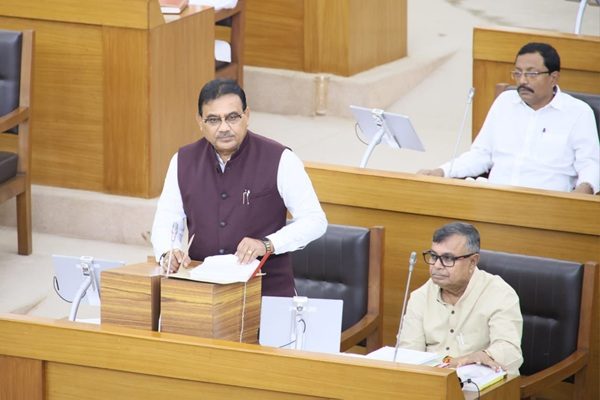
Tripura Finance Minister Pranajit Singha Roy on Monday presented the State Budget for the financial year 2026–27 in the Legislative Assembly, proposing a total outlay of ₹34,212.31 crore. The budget estimates a deficit of ₹240.72 crore while outlining several initiatives aimed at strengthening infrastructure, social welfare and economic growth across the state.
Presenting the budget on the second day of the ongoing Budget Session, chaired by Deputy Speaker Ramprasad Paul, the Finance Minister said this year’s budget allocation has increased by 5.52 percent compared to the previous financial year.
The capital expenditure for the upcoming fiscal has been fixed at ₹8,945.92 crore, which is 13.19 percent higher than the estimated capital outlay for the financial year 2025–26. The minister informed the House that the increased capital spending reflects the state government’s emphasis on infrastructure development and long-term economic growth.
The budget also proposes a Supplementary Grant of ₹4,676.81 crore. Notably, the Finance Minister announced that no new taxes have been proposed in the budget, providing relief to citizens while focusing on development and welfare-oriented spending.
Sector-wise allocations indicate significant investments in key areas. The government has proposed ₹2,441.50 crore for the health sector, marking an increase of 25.29 percent compared to the previous budget. The allocation aims to strengthen healthcare infrastructure and expand medical services across the state.
For rural development, an allocation of ₹4,094.57 crore has been proposed, reflecting an increase of 17.50 percent over the previous year’s budget. The agriculture and allied sectors have been allocated ₹1,985.61 crore, representing a 5.31 percent increase. Meanwhile, the education sector will receive ₹6,439.56 crore, which is 4.43 percent higher than the allocation made in the previous financial year.
The budget, which focuses on building a “Viksit Tripura,” includes several new schemes aimed at promoting inclusive development. These initiatives target areas such as Janajati welfare, healthcare, education, employment generation, road infrastructure, industrial growth and farmers’ welfare.
Highlighting the government’s commitment to tribal welfare, the Finance Minister announced that the state government will provide ₹914.82 crore to the Tripura Tribal Areas Autonomous District Council (TTAADC) during the financial year 2026–27. This allocation is in addition to funds provided under schemes such as RIDF and SASCI for capital infrastructure development.
The total provision under the Tribal Sub Plan (TSP), including allocation to the TTAADC, has been kept at ₹7,542.06 crore. According to the Finance Minister, most of these funds will be utilized in areas under the TTAADC, accounting for approximately 39.39 percent of the state’s total development expenditure.
The budget also outlines proposals aimed at strengthening technical education. The government has proposed the construction of a new Industrial Training Institute at Pecharthal and the establishment of a Drone School to professionally train drone pilot operators with licenses approved by the Directorate General of Civil Aviation (DGCA).
In the field of medical education, the government plans to set up an Ayurvedic Medical College in Gomati district and a Homoeopathic Medical College at Netaji Subhas State Homeopathy Hospital in Agartala. Each institution will have an intake capacity of 60 seats and is expected to start from the next academic session. Additionally, the state government has announced plans to establish the Tripura University of Health Sciences.
Significant emphasis has also been placed on the development of the IT sector and digital infrastructure. The budget proposes the establishment of the Tripura IT & Data Ecosystem Zone (TIDEZ) at Chanmari in Agartala to attract investment in IT, IT-enabled services and data centres.
Other initiatives include the launch of the “NAVCHETNA” programme aimed at promoting technology-driven education by introducing artificial intelligence, robotics, Internet of Things (IoT), coding and automation through innovation and technology laboratories in educational institutions.
The government has also proposed an AVGC-XR (Animation, Visual Effects, Gaming, Comics and Extended Reality) policy to promote the Orange Economy and position Tripura as a hub for creative technology, digital content and immersive media. The policy is expected to encourage innovation, skill development and employment generation.
Further proposals include the development of Agartala AI City as a flagship digital infrastructure initiative, featuring a modern IT park to promote artificial intelligence, IT/ITeS, startups and innovation. The government also plans to establish a Cyber Security Operation Centre (CSOC) in Agartala to strengthen the state’s digital security ecosystem.
During his speech, the Finance Minister also noted that Tripura has witnessed a significant decline in the overall crime rate and highlighted several initiatives aimed at boosting the tourism sector.
He stated that the budget has been carefully prepared with a vision to ensure inclusive development and improve the welfare of all sections of society, including Janajati communities, minorities and other marginalized groups.