Agartala, Dec 3:
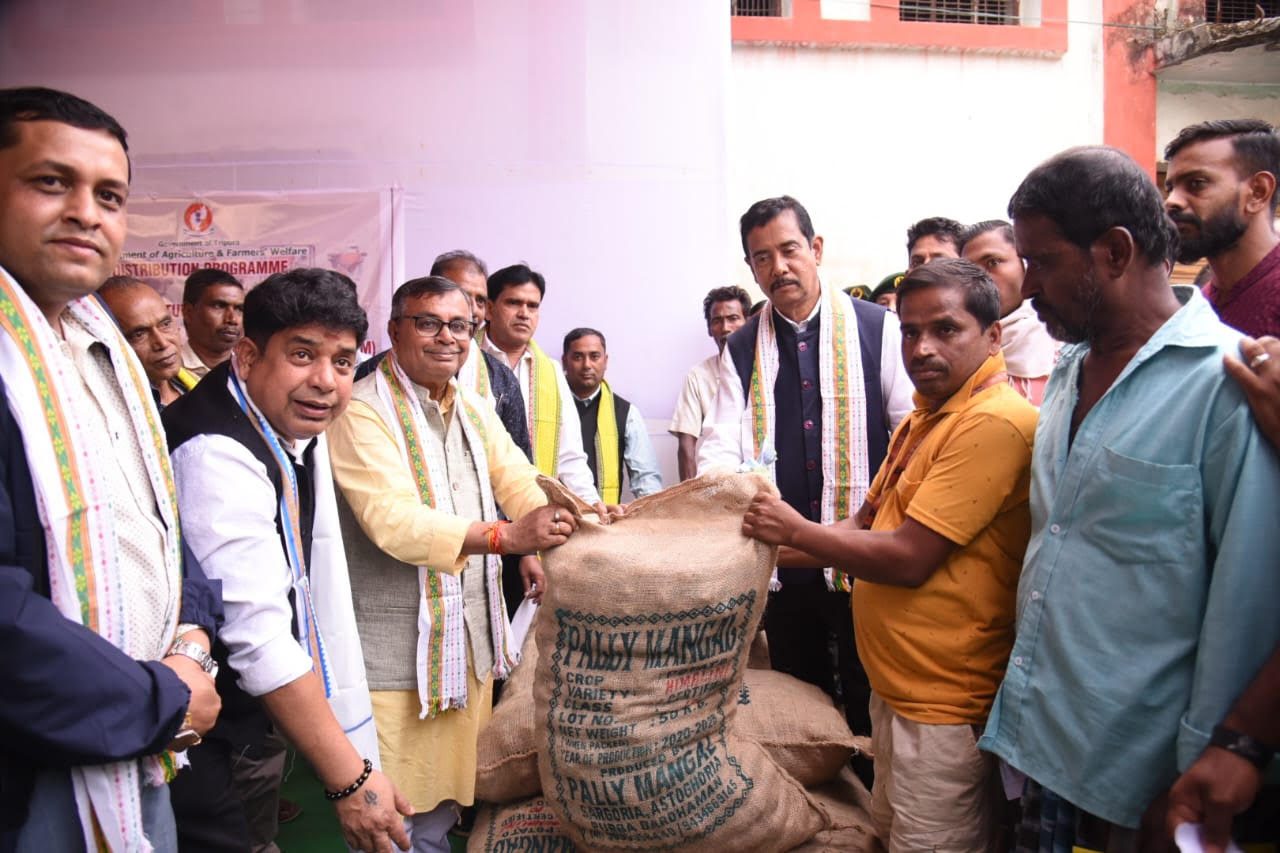
Tripura Agriculture and Farmers’ Welfare Minister Ratan Lal Nath on Tuesday stressed the need for self-reliance in the agriculture sector, aligning with Prime Minister Narendra Modi’s mission to transform India into a global grain store. He made the remarks while distributing modern agricultural equipment—including tree saplings and spray machines—to farmers under the Mohanpur Agriculture Sub-Division.
According to a press release, the Minister said the initiative holds great importance for modernising farming practices, enhancing productivity, and empowering farmers with improved resources. He noted that advanced tools and scientific support would enable farmers to cultivate more efficiently, thereby accelerating Tripura’s agricultural growth.
Highlighting the urgent need for self-sufficiency, Nath said Tripura must advance rapidly across all sectors through planned development. “Along with progress, we must become self-reliant. If districts like North Tripura, Gomati, or Sepahijala refuse to supply rice, where will we get it from? This is why self-reliance is essential,” he said.
He added that Mohanpur Block must work towards becoming fully self-sufficient in food production. “We must contribute to the Prime Minister’s dream of turning India into a grain store from which other countries will import food. Our foundation lies in agriculture,” Nath stated.
The Minister also addressed misconceptions about certain crops, noting that agricultural scientists have proved that onion cultivation is feasible in Tripura. “We now cultivate both red and white onions. Onion and potato cultivation are receiving top priority. If we ensure adequate production of rice, onion, potato, and pulses, no one will have to worry,” he said.
Nath further highlighted Tripura’s expanding agricultural footprint, mentioning that India exports fish to the USA, China, Europe, and Japan, and eggs to Oman, Qatar, Sri Lanka, and Maldives. Tripura also exports agricultural products to Bangladesh and Pakistan, reinforcing the region’s growing role in agri-trade.