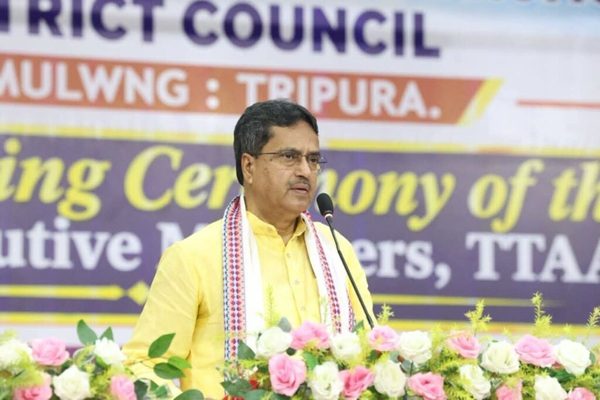
Agartala, Nov 10 : Tripura Chief Minister Manik Saha on Tuesday stressed the need for closer coordination between the state government and the Tripura Tribal Areas Autonomous District Council (TTAADC), saying neither institution could independently fulfil the developmental aspirations of tribal communities.
Addressing the oath-taking ceremony of newly appointed Executive Members (EMs) of the TTAADC at Nuai Auditorium in Khumulwng, Saha said mutual trust, administrative partnership and continuous dialogue were essential for improving the living standards of people in tribal areas.
“The TTAADC and the state government are complementary institutions. Neither can function effectively in isolation. Development cannot be achieved if both work separately,” he said.
The ceremony was attended by Lok Sabha MP Kriti Singh Debbarma, TIPRA Motha founder Pradyot Kishore Debbarma, Tribal Welfare Minister Bikash Debbarma, TTAADC Chief Executive Member Runiel Debbarma, veteran tribal leaders Bijoy Kumar Hrangkhawl and Jagdish Debbarma, legislators and senior officials.
Congratulating the newly inducted members, the chief minister urged them to prioritise public welfare, transparency, accountability and administrative efficiency.
Referring to the Sixth Schedule of the Constitution, Saha said it protects the rights of indigenous communities over land, language, culture, customs and socio-economic interests while providing a framework for self-governance.
He said differences between the state government and the autonomous council should be resolved through constructive discussions rather than confrontation.
Saha also welcomed Pradyot Kishore Debbarma’s assurance that he would continue to stand by the Tiprasa community despite his decision to step away from active electoral politics.
On infrastructure, the chief minister said household tap water coverage had improved significantly across Tripura, though remote and hilly areas continued to face challenges. The government was exploring alternative technologies to ensure safe drinking water reaches every household, he added.
He said a special committee had been constituted to examine schools in ADC areas with very low enrolment, while the government was considering converting some institutions into residential schools.
Saha also highlighted plans to strengthen residential education facilities for tribal students on the lines of the Eklavya Model Residential School system.
Emphasising healthcare improvements, he said government-backed health insurance schemes and better medical infrastructure should benefit people in remote tribal areas.
Assuring the newly appointed EMs of full government support, Saha said his doors would remain open for discussions on developmental issues.
He called for stronger institutional cooperation, financial discipline and administrative accountability to ensure inclusive and sustained development in tribal areas.