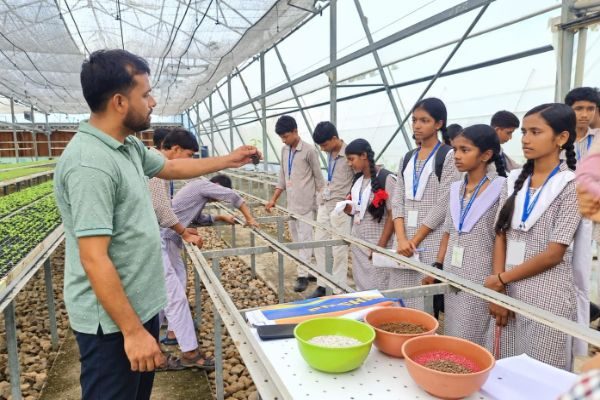
Agartala, September 23: Students of Class IX at PM SHRI South Jumerdhepa High School in Sepahijala district participated in an Agriculture Trade industrial visit aimed at providing practical exposure under Tripura’s NSQF-based vocational education programme.
The field visit enabled the students to observe agricultural activities first-hand and understand the application of vocational concepts beyond the classroom.
According to a press note, the programme was designed to introduce students to agriculture as a skill-oriented field while giving them an understanding of workplace practices and potential employment opportunities.
Valeur Fabtex Pvt. Ltd., the Vocational Training Provider (VTP) associated with the school, facilitated the programme. The students were accompanied by the school’s Vocational Trainer, with the initiative conducted under the leadership of Ikram Hossen, State Coordinator of the organisation, in coordination with the school and the School Education Department.
The visit forms part of the Vocationalisation of School Education programme under the National Skill Qualification Framework (NSQF), which is intended to combine mainstream schooling with practical skill development and industry-oriented learning.
For the academic year 2025-26, the Project Approval Board (PAB) of Samagra Shiksha and the PM SHRI Scheme, under the Ministry of Education, approved the rollout of NSQF-compliant vocational education in seven sectors across 191 selected government high and higher secondary schools in Tripura.
The seven sectors are IT–ITeS, Electronics, Agriculture, Organised Retail, Power, Automotive and Telecom.
Under the approved plan, 138 schools will introduce a first vocational sector, while 53 schools where vocational education is already available will add a second sector.
The programme is being implemented by the Tripura School Education Department through Samagra Shiksha and the PM SHRI Scheme, with support from the designated VTP.
The Agriculture Trade visit provided students with direct exposure to practical learning and allowed them to connect academic lessons with actual work situations.
Such initiatives are intended to improve students’ practical understanding, workplace awareness, communication and problem-solving abilities while introducing them to career possibilities in agriculture, the press note said.
The programme follows the “Learning by Doing” approach and seeks to equip students with practical skills, confidence and greater awareness of future education and employment opportunities.