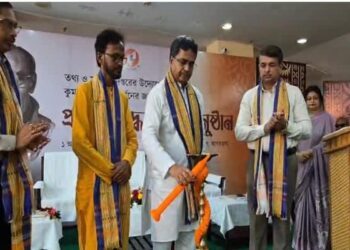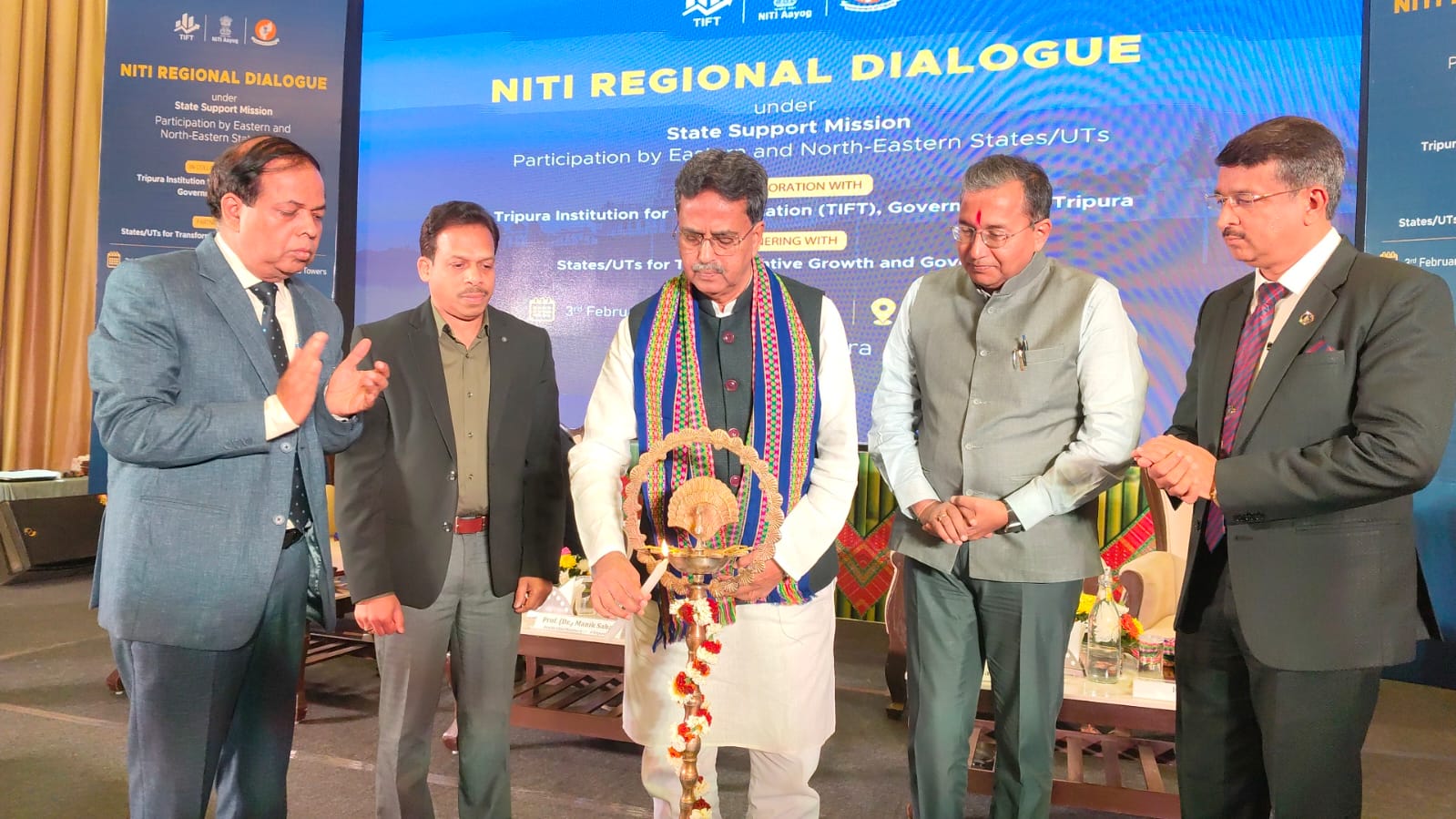
Agartala: Chief Minister Prof. Dr. Manik Saha today said that the state government is in the process of establishing an international skill centre and a foreign language school, opening global employment opportunities for the youth of the state.
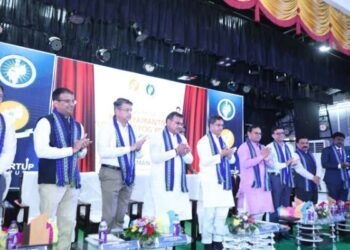
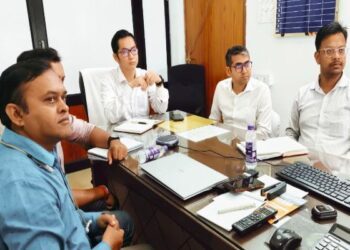
Dr. Saha said this while addressing the 3rd Regional Workshop under the State Support Mission of NITI Aayog at Hotel Polo Towers in Agartala today.
He said that governance, after all, is not merely about institutions or procedures.
“It is fundamentally about improving the quality of life for every citizen and ensuring that development reaches the last mile, as our Prime Minister used to say. The State Support Mission represents a defining evolution in India’s federal governance architecture,” he said.
Dr. Saha said that it underscores a partnership-based model of Centre-State collaboration, recognizing that states are not merely implementing agencies but equal partners in shaping India’s development journey.
“Through the State Support Mission, NITI Aayog has empowered states to strengthen their State Institutes of Transformation—institutions that support policy design, outcome monitoring, and inter-sector convergence. The mission acknowledges that sustainable socio-economic transformation is rooted in strong institutions, and it helps align the long-term visions of states with the national aspiration of Viksit Bharat 2047,” he said.
He also said that today, states and Union Territories are at varying stages of development of the State Institute of Transformation, reflecting diverse governance and socio-economic contexts.
“Recognizing this diversity, NITI Aayog has conceptualized regional workshops as platforms for peer learning, cross-fertilization of ideas, and collaborative problem-solving. The decision to host the third regional workshop for eastern and northeastern states in Tripura reflects NITI Aayog’s confidence in the region’s growing policy capacity and in Tripura’s readiness to contribute meaningfully to the national reform discourse. Over the past few years, Tripura has consistently placed good governance and institutional reform at the heart of its development strategy,” said Dr. Saha.
Dr. Saha said that in a short span, TIFT has emerged as a catalyst for reform and a vital bridge between policy intent and on-ground execution.
“It works closely with leading knowledge institutions to identify Tripura’s core strengths, set realistic targets, and develop sectoral roadmaps. Over the last two years, TIFT has played a critical role in addressing key governance challenges. TIFT has also been hand-holding government departments in policy formulation and business reforms. We are in the process of establishing an international skill centre and a foreign language school, opening global employment opportunities for our youth. Earlier, our youth used to go outside the state, and if they have knowledge of foreign languages, it becomes easier for them to go abroad and communicate,” he said.
Dr. Saha said that recognizing that good governance requires modern tools for service delivery and infrastructure creation, the state government has established a PPP cell within the Good Governance Department. This cell facilitates private investment while optimally sharing risk with the government.
“Prime Minister Narendra Modi graciously appreciated Tripura’s reform efforts during my interaction with him when I went to Delhi and met him. Our business reform strategy was shared with all states at the 5th Chief Secretaries’ Conference in December 2025. In January 2026, the government of Bihar, along with some other states, invited our officers to study the Tripura model of ease of doing business,” said Dr. Saha.
He informed that the Jindal Group has commenced steel sheet manufacturing, and several private universities as well as medical and paramedical colleges have been established in the state.