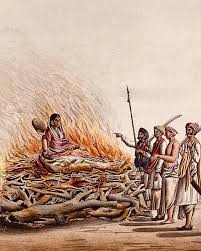
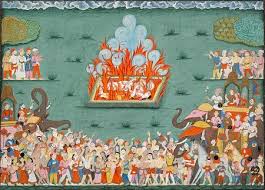
The practice of Sati—also referred to as Satidah Pratha—has long been projected as an ancient Hindu tradition. However, a closer examination of religious scriptures, historical records, and social history reveals that this belief is largely a misconception. There is no clear sanction, instruction, or compulsion for Sati in core Hindu texts such as the Ramayana, Mahabharata, or the Bhagavad Gita. Instead, Sati appears to have emerged much later as a social distortion shaped by feudal patriarchy, political instability, and misinterpretation of customs—particularly during the medieval and colonial periods.
Absence of Sati in Hindu Scriptures
The Ramayana provides one of the strongest counter-arguments to the claim that Sati is an ancient religious duty. After the death of King Dasharatha, none of his wives—Kaushalya, Kaikeyi, or Sumitra—committed Sati. They continued to live with dignity and respect. Similarly, in the Mahabharata, despite large-scale warfare and the death of many kings, queens like Gandhari, Kunti, and Draupadi did not self-immolate. Gandhari lived for years after the death of Dhritarashtra.
The Bhagavad Gita, considered the philosophical core of Hindu thought, emphasizes karma (duty), ahimsa (non-violence), self-realization, and devotion. It does not glorify death, self-harm, or the sacrifice of women in any form. On the contrary, Hindu philosophy traditionally views life as sacred and prescribes sanyasa (renunciation) or spiritual pursuit for widows—not death.
Then Where Did Sati Come From?
Historically, Sati seems to have originated as a rare, localized custom, not a widespread religious mandate. Early references to widow self-immolation appear sporadically in post-Gupta-era inscriptions (around 5th–7th century CE), mostly among warrior elites. Over time, especially during periods of foreign invasions and political chaos, Sati began to be linked with ideas of “honour,” inheritance control, and male lineage protection.
During medieval times, the practice gained more ground in certain regions due to:
Patriarchal control over women’s bodies and property
Fear of widows remarrying and claiming inheritance
Glorification by court poets and feudal elites
Social pressure rather than voluntary choice
It is important to note that most cases of Sati were not voluntary. Many women were coerced, drugged, or socially blackmailed into the act.

Role of the British Period
Contrary to popular belief, Sati did not end with British rule—it became more visible and documented during this time. British administrators recorded Sati incidents in detail, particularly in Bengal, Bihar, Rajasthan, and parts of present-day Uttar Pradesh. This documentation created the false impression that Sati was universally prevalent in ancient India.
In regions like West Bengal and nearby states, several cases were registered in the late 18th and early 19th centuries. Social reformers such as Raja Rammohan Roy strongly opposed the practice, citing scriptural evidence against it. His efforts, combined with growing resistance from Indian intellectuals and women, led to the Bengal Sati Regulation Act of 1829, which legally abolished Sati under Governor-General Lord William Bentinck.
Importantly, the British ban did not “introduce reform” out of benevolence alone; it followed intense Indian-led reform movements and public outcry.
Conclusion
Sati Pratha was neither an essential Hindu ritual nor a practice endorsed by sacred scriptures. It was a social evil that evolved due to historical circumstances, patriarchal dominance, and power structures—later falsely branded as “tradition.” The absence of Sati in the Ramayana, Mahabharata, and Geeta is not accidental; it reflects the fundamentally life-affirming and ethical nature of Hindu philosophy.
Understanding this distinction is crucial—not only to correct historical narratives but also to ensure that religion is not blamed for practices born out of social injustice. Sati stands today as a reminder of how customs can be manipulated—and how reform, reason, and courage can ultimately prevail.